Every growing company eventually meets the same problem: the system that got you this far is now the thing holding you back. It is slow, hard to change, and only one or two people really understand it. Yet you cannot simply switch it off. Orders, customers and payments depend on it.
The good news is that legacy modernisation does not have to be a risky big-bang project. This guide explains a practical, staged approach that suits small and mid-sized businesses in the UK, the US, the UAE, Saudi Arabia and beyond.
Signs it is time to modernise
Not every old system needs replacing. Look for these warning signs:
- Simple changes take weeks or months.
- The system cannot connect to modern tools, payment providers or messaging channels.
- Reports are slow, manual or unreliable.
- Outages are becoming more frequent.
- You depend on one person who knows how it works.
- Security updates are no longer available.
If two or three of these sound familiar, the cost of doing nothing is probably already higher than you think.
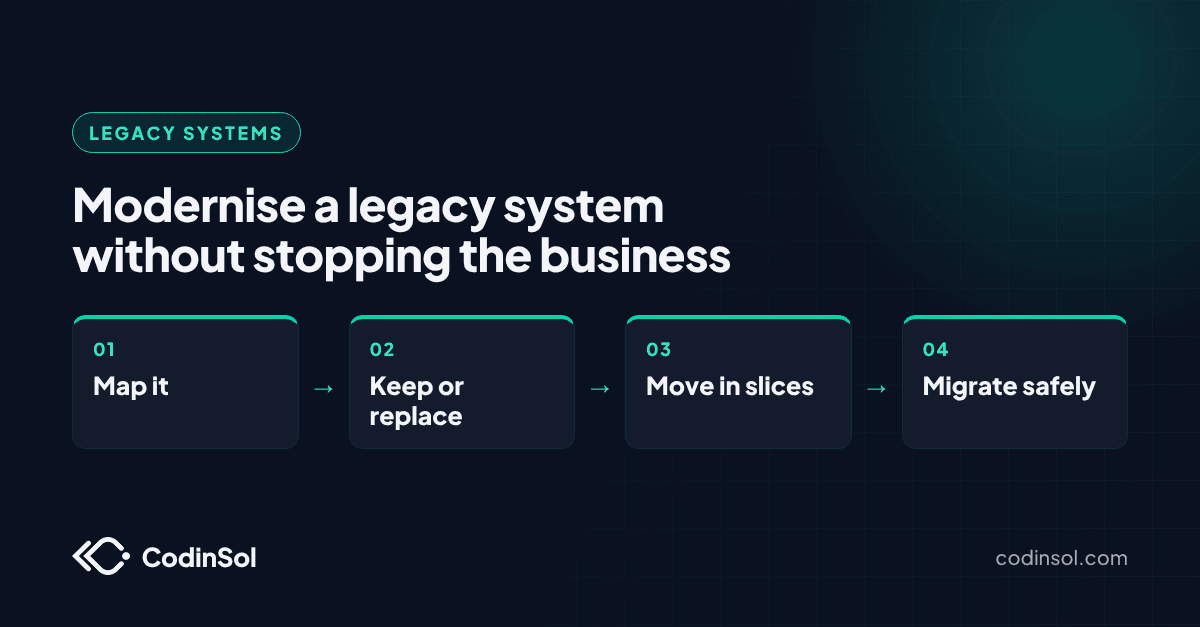
Step 1: Map what the system actually does
Before touching any code, document the real behaviour of the system. Talk to the people who use it every day, not just those who manage it. List the workflows, the data it holds, the other systems it talks to, and the reports people rely on.
This often reveals that parts of the system are no longer used at all. Those parts do not need to be rebuilt, which saves time and budget.
Step 2: Decide what to keep, replace or retire
For each part of the system, choose one of three paths:
- Keep: it works well and carries little risk.
- Replace: it is a bottleneck or a security concern.
- Retire: nobody needs it any more.
This simple triage turns an overwhelming project into a clear list of smaller pieces.
Step 3: Modernise in slices, not in one go
The safest approach is to replace the system gradually. Pick one valuable, self-contained area first, such as customer notifications, booking, billing or reporting. Build the new version alongside the old one, connect them through an integration layer, and move users across once it is proven.
Each slice delivers value on its own, and if something goes wrong, you can roll back without losing the business.
Step 4: Plan the data migration carefully
Data is usually the hardest part. Allow time to:
- Clean duplicates and outdated records.
- Agree how old fields map to the new structure.
- Run test migrations and compare results.
- Keep a rollback plan for go-live day.
Our team has experience migrating legacy call-centre systems and their data to the cloud, and the lesson is consistent: rehearse the migration several times before the real one.
Step 5: Add useful automation and AI where it helps
Once the foundations are modern, you can add features that were impossible before. Examples include AI summaries of customer conversations, an assistant that handles routine questions, automated reminders and smarter reporting. Add these only where they solve a real problem, not because they are fashionable.
Step 6: Test, release and keep supporting
Run the old and new systems side by side for a short period. Test with real users and real scenarios, then release in stages. After launch, monitor performance and gather feedback, because the first month in production always teaches you something.
Common mistakes to avoid
- Rebuilding everything at once.
- Copying every old feature without asking whether it is needed.
- Leaving migration testing until the end.
- Ignoring the people who use the system daily.
Final thoughts
Modernising a legacy system is less about technology and more about sequencing. Understand what you have, move one piece at a time, protect your data, and keep the business running throughout.
Book a free consultation
If you are weighing up what to do with an ageing system, CodinSol can help you plan a safe, staged route forward. Book a free consultation and we will talk through your options with no obligation.