Many business leaders assume that adding AI means replacing their current systems. In most cases it does not. If your CRM, booking system, internal tool or customer portal works reasonably well, you can add AI features to it step by step. This guide explains how to do that sensibly.
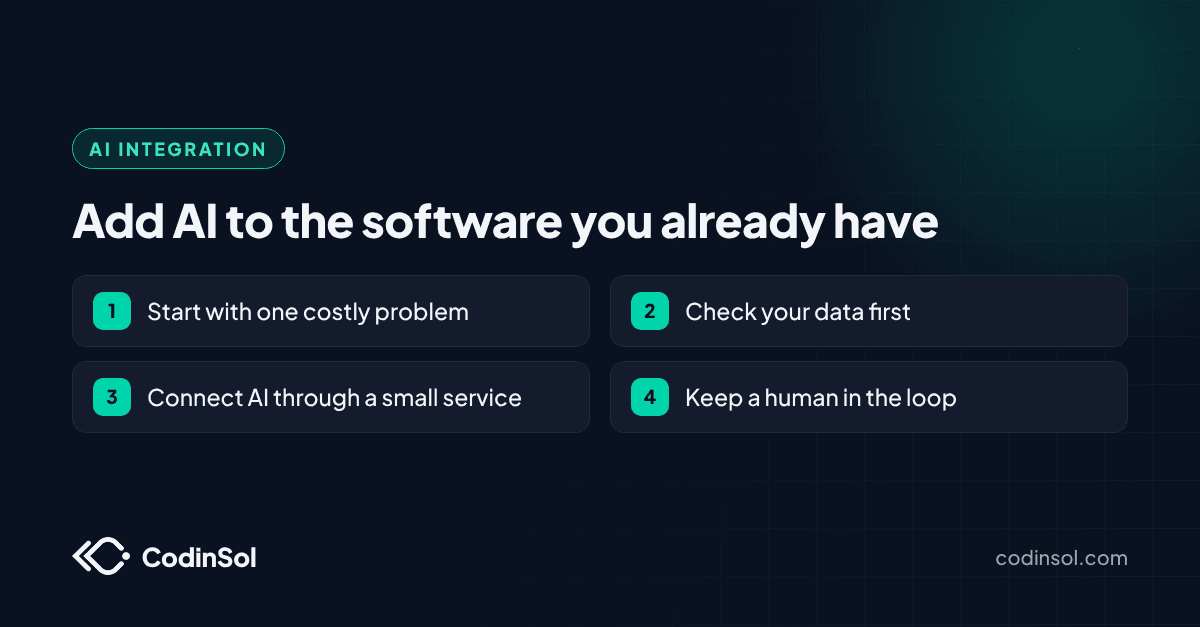
Start with a problem, not a technology
The most common mistake is starting with the question "Where can we use AI?" A better question is "Where does our team lose time, or where do customers wait?"
Good candidates tend to be:
- Answering the same customer questions again and again
- Summarising long emails, tickets or call notes
- Sorting and routing incoming requests
- Drafting replies for a person to review
- Searching internal documents quickly
Pick one problem, write down how it is handled today and measure how long it takes. This gives you a baseline to judge success against.
Check your data before anything else
AI features are only as good as the information behind them. Before you build, ask:
- Is the information accurate and up to date?
- Is it stored in one place, or scattered across tools?
- Who is allowed to see it?
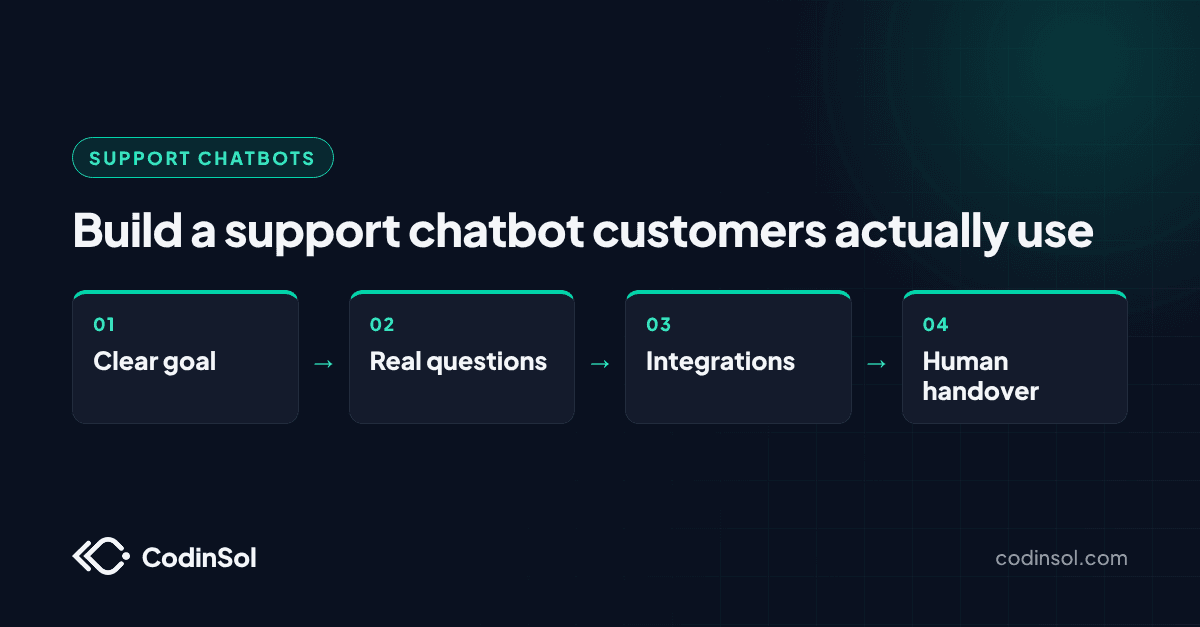
For a customer chatbot, for example, the quality of your help articles and policies matters more than the choice of model. Tidying content first often delivers more improvement than any technical change.
Choose the right type of AI feature
Not every problem needs the same approach.
Assistants and chatbots suit common questions, bookings and simple requests. They work well on web chat and WhatsApp, which is especially important for customers across the UAE, Saudi Arabia and the wider Middle East.
Summarisation and drafting suits support teams, sales teams and operations staff who read a lot of text.
Automation with AI steps suits workflows such as classifying an incoming request and sending it to the right team.
Search over your own documents suits businesses with large amounts of policy, product or technical information.
In many cases a simple rules-based tool works as well as AI. Use AI where judgement or language understanding is genuinely needed.
Connect AI through integrations
You rarely need to rewrite your core system. Instead, a small service sits between your existing software and the AI model. It receives data, sends a request, checks the answer and returns the result to the tool your team already uses.
This keeps risk low. Your current system keeps running, and you can switch the AI part on or off without disrupting daily work.
Keep a human in the loop
For the first release, let AI suggest and let people approve. A support agent can review a drafted reply before sending it. A manager can confirm a suggested classification. Over time, as you see how accurate the feature is, you can automate the low-risk cases and keep people for the complex ones.
Also plan for what happens when the AI is unsure. A clear fallback to a person protects your customers and your reputation.
Think about security and privacy early
Decide what information may be sent to an AI model and what must stay private. Apply role-based access so people only see what they should. Log requests so you can review mistakes. If you operate in the UK, EU, USA or Gulf states, check which data-protection rules apply to your customers.
Run a small pilot and measure it
Launch to a small group first. Compare results with your baseline: time per task, customer waiting time, number of escalations and user feedback. Adjust, then expand.
A typical pilot can be delivered in a few weeks when the scope is tight. Weekly demos help you spot problems early and keep the work aligned with what your team needs.
Plan for ongoing improvement
AI features need care after launch. Questions change, products change and policies change. Set aside time to review conversations, update content and refine prompts or rules.
Final thoughts
Adding AI to existing software is less about big transformation and more about choosing one useful improvement, connecting it safely and learning from real use. Done this way, it is practical for growing businesses of any size.
Book a free consultation
Thinking about adding an AI assistant, automation or summarisation to your current systems? Book a free consultation with CodinSol and we will help you identify the best first step.