A support chatbot can reduce workload and speed up answers for your customers. A poorly planned one frustrates people and sends them straight to your inbox. This guide walks through a practical way to plan, build and launch a chatbot for a growing business.
1. Start With a Clear Goal
Before choosing any technology, decide what the chatbot is for. Good goals are specific:
- Answer order status questions without an agent
- Book appointments and send reminders
- Qualify new enquiries before passing them to sales
- Collect details so an agent can resolve a case faster
Avoid the goal "handle all support". It is too broad and almost impossible to measure.
2. Look at Your Real Conversations
Pull a sample of recent emails, calls and chats. Group them by topic. In most businesses, a handful of topics account for a large share of the volume. These are your first candidates for automation.
A retailer in Manchester might find that delivery tracking dominates. A clinic or service business in Dubai might find that booking changes do. Let the data decide, not assumptions.
3. Decide Where AI Helps and Where Rules Are Enough
Not every chatbot needs AI. A simple rules-based flow works well for predictable tasks such as booking a slot or checking a status.
AI is useful when customers phrase things in many different ways, or when answers must be drawn from a large set of documents. A language model can understand the question and respond in natural language, ideally using only your approved content.
Many of the best solutions combine both: structured flows for transactions, AI for open questions.
4. Connect It to Your Systems
A chatbot that cannot see orders, bookings or accounts can only give generic answers. Integration is what makes it genuinely useful. Plan which systems it needs to read from, and which actions it may perform, such as rescheduling or raising a ticket.
Security matters here. Limit access to what is needed, verify identity before sharing personal details, and keep a log of actions.
5. Design the Handover to a Human
Every chatbot will meet questions it cannot answer. Decide in advance:
- When does it hand over? (low confidence, frustration, sensitive topics)
- Who receives the conversation?
- Does the agent see the full history, so the customer does not repeat themselves?
A smooth handover often matters more than the bot's cleverness.
6. Choose Your Channels
Go where your customers already are. In the UK and US that may be your website chat and email. In the UAE, Saudi Arabia and the wider Middle East, WhatsApp is often the most natural channel. Support Arabic and English if your audience uses both, and test the quality of each language separately.
7. Launch Small, Then Improve
Release the chatbot for one or two use cases first. Watch real conversations, note where it fails, and improve weekly. Useful measures include:
- Percentage of conversations resolved without an agent
- Customer satisfaction after a chat
- Handover rate and reasons
- Questions the bot could not answer
These show you what to build next.
8. Keep It Maintained
Products, prices and policies change. Assign an owner to keep the content current and review conversations regularly. A chatbot is a living product, not a one-off project.
Common Mistakes to Avoid
- Trying to automate everything at once
- Hiding the option to speak to a person
- Launching without testing on real customer questions
- Ignoring data privacy and consent requirements in your market
Final Thoughts
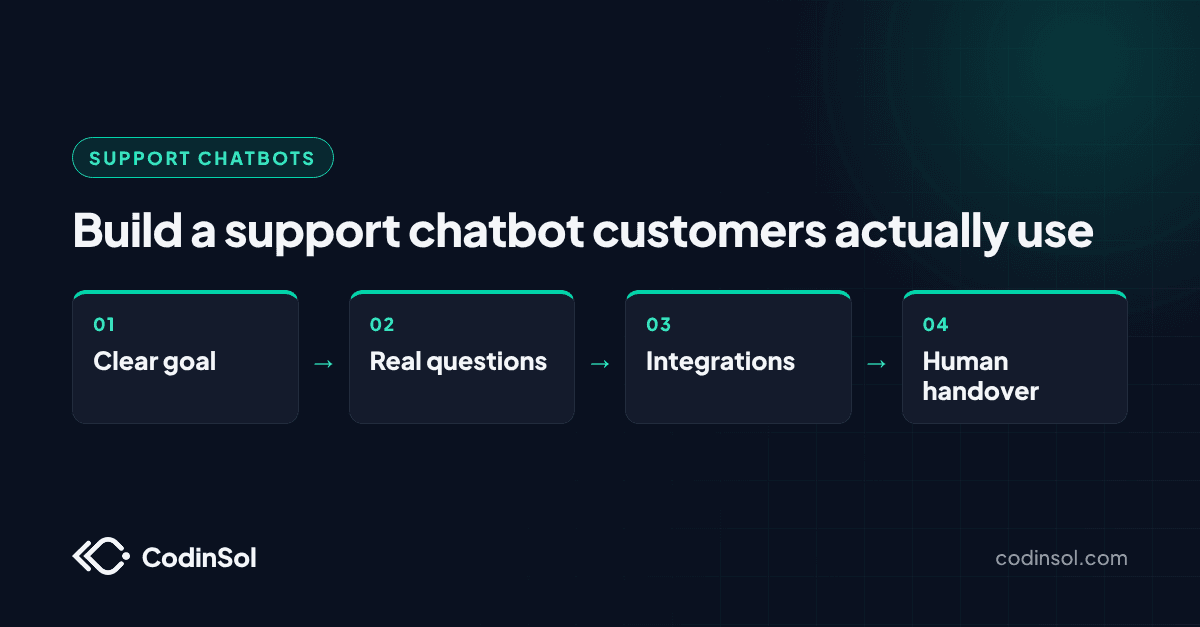
A good support chatbot is built around a clear goal, real customer questions, solid integrations and a dependable handover. Start small, measure honestly and expand step by step.
Talk to CodinSol
CodinSol designs and builds AI-powered chatbots and assistants for growing businesses, from first discovery to ongoing support. If you would like to explore what a chatbot could do for your team, book a free consultation and we will help you find the best place to start.